A depot for a thousand beggars
On the heath between Merksplas and Rijkevorsel, the Society of Benevolence built a colony where beggars and vagrants were locked up and put to work. The register on this website is the list of those who stayed there between 1825 and 1842.
Poverty as a crime
In the early nineteenth century, begging and vagrancy were punishable. Under French rule, every department was given a dépôt de mendicité, a beggars' depot, in Dutch a bedelaarsgesticht. This is how the depots of Ter Kameren (La Cambre) near Brussels, Bruges, Rekem, Mons, Namur and Hoogstraten came about. Anyone who was picked up was first taken to a house of arrest and then to one of these depots.
In 1821 Prince Frederick founded the Society of Benevolence for the Southern Provinces (Maatschappij van Weldadigheid voor de Zuidelijke Provinciën) in Brussels, modelled on the colonies in Drenthe. It wanted to give the poor a livelihood by having them reclaim waste land. Wortel got a free colony with farms for poor families. Merksplas got an unfree colony: a closed depot for beggars.
The contract
In 1823 the government signed a contract with the Society: it could take in a thousand beggars and would receive a yearly grant for sixteen years in return. The cost per beggar was charged to his or her relief domicile. That is why the register carefully notes, next to each name, which depot or authority someone came from and which municipality had to pay.
The depot was inaugurated on 25 August 1825. The first entries in the register date from a few weeks later: whole groups were transferred from the existing beggars' depots.
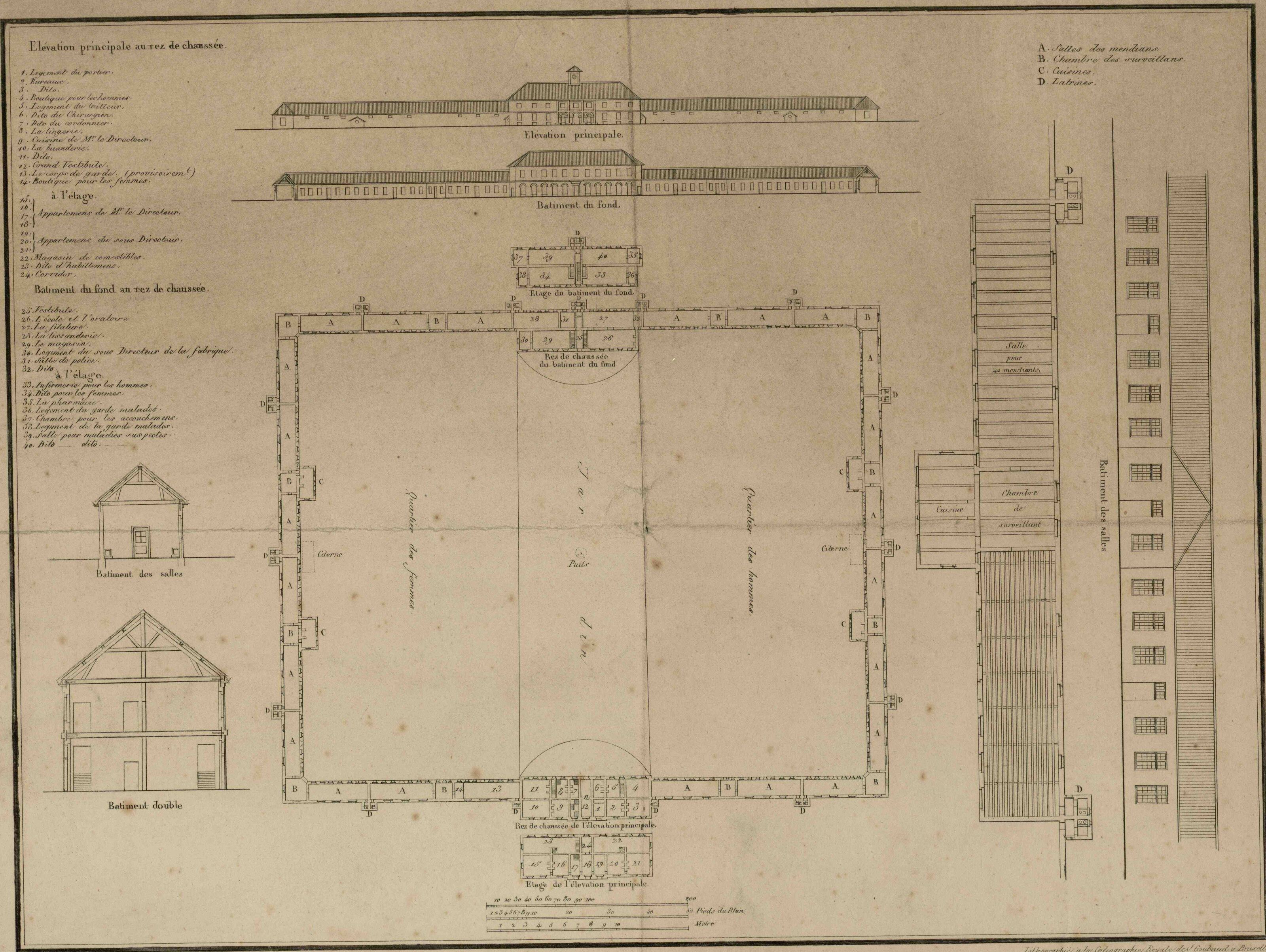
Plan du bâtiment construit par la société de bienfaisance des
Provinces Méridionales, au milieu des bruyères près de Merxplas-Ryckevorsel, et servant de dépôt
pour mille mendiants valides, opened on 25 August 1825. Click to enlarge.
What the plan shows
Four low wings form a closed rectangle around a large inner garden with a well. The garden is divided in two: on the left the quartier des femmes (women's quarter), on the right the quartier des hommes (men's quarter). Men and women lived apart, even when they had arrived as a family.
- A Halls for the beggars. One such hall is drawn separately on the right of the plan.
- B Rooms for the overseers, between the halls.
- C Kitchens.
- D Latrines.
The director and the deputy director lived in the main building. It held offices, a guardroom, a linen room, a laundry, a shop for the men and one for the women, and lodgings for the tailor, the shoemaker and the surgeon. The rear building housed the school and the chapel, a spinning mill, a weaving shop and a storehouse, and on the upper floor the sick wards, the pharmacy and a room for childbirth.
The end
After Belgian independence in 1830 the Society ran into trouble. There were many escapes, debts mounted and the Belgian state stopped the grant in 1839. On 1 October 1842 the Society was dissolved. The last departure dates in the register fall in those same weeks.
In 1870 the Belgian state bought the estates of Wortel and Merksplas. They became state colonies of benevolence (Rijksweldadigheidskoloniën), where vagrants were locked up until 1993. Other registers exist for that later period: they are not part of this register.
Timeline
- The beggars' depot of the Department of the Two Nethes, today the province of Antwerp, moves to Hoogstraten castle.
- Prince Frederick founds the “Society of Benevolence for the Southern Provinces of the Kingdom” in Brussels.
- In the autumn the first families arrive in the free colony of Wortel.
- Contract with the government to take in a thousand beggars. The Society buys land in Merksplas.
- First stone laid for the beggars' depot of Merksplas-Rijkevorsel.
- Opening of the depot. Start of the register.
- Belgian independence. The Society loses support and income.
- The Society of Benevolence for the Southern Provinces is dissolved on 1 October. End of the register.
Glossary
The register is kept in Dutch. This glossary gives the Dutch words you will come across in the records, with their meaning.
- Register (stamboek)
- The register in which beggars were entered on admission to the depot, recording name, age or date of birth, origin, date of admission, and the date of and reason for leaving.
- Relief domicile (onderstandswoonst, OW)
- In French domicile de secours. The municipality that was legally required to pay for the support of a pauper: in principle the place of birth, unless someone had lived long enough in another municipality. It had nothing to do with the place where someone was picked up.
- Coming from (komende van)
- The institution or authority that sent someone to the beggars' depot.
- Beggars' depot (bedelaarsgesticht)
- A closed institution where beggars and vagrants were locked up and had to work. In French dépôt de mendicité.
- Arresthuis, bewaarhuis, verzekeringshuis
- Prisons where suspects and people serving short sentences were held. Anyone convicted of begging went from there to a beggars' depot.
- Public prosecutor (Procureur des Konings)
- The magistrate who prosecuted before the court and had convicted beggars transferred to the depot. Abbreviated in the register to Proc. Kon.
- Discharged (ontslagen)
- Released from the depot.
- Escaped (ontvlucht, VLU)
- Ran away. Anyone who was brought back got a new entry with the note terug na VLU, "back after escaping".
- Collected (afgehaald)
- Fetched from the depot by someone.
- National Militia (Nationale Militie, N.M.)
- Conscription. Young men who were called up left the depot as a milicien, a conscript.
- Overseas possessions (overzeese bezittingen)
- Some men left the depot to enlist in the colonial troops, raised to uphold Dutch rule in the Dutch East Indies and elsewhere.
- Free and unfree colony (vrije en onvrije kolonie)
- In the free colony of Wortel, poor families lived on a farm of their own. The unfree colony of Merksplas-Rijkevorsel was a closed depot.
Sources
The data about people come exclusively from the register, as it was transcribed from the original register. The historical notes on this page are based on:
- A. Cosemans, Inventaire des archives de la Société de Bienfaisance de Bruxelles: colonies de mendiants de Wortel et Merxplas, National Archives of Belgium (Algemeen Rijksarchief), finding aid T 306. Inventory on Agatha. The archive of the Society, with the population registers of the colonies, is kept at the National Archives of Belgium in Brussels.
- Flemish heritage inventory (Inventaris van het Onroerend Erfgoed, in Dutch): Rijksweldadigheidskolonie Merksplas and Wortel-Kolonie.
- Colonies of Benevolence, on the Unesco inscription.
- The plan of the depot, for the layout of the buildings.
Looking for someone who stayed in the state colony of benevolence of Hoogstraten, Wortel or Merksplas (or Rekem) after 1870? The search tool “Zoek je voorouders” (Find your ancestors) will help you on your way.